You are here: Home » Resources »
From career ideas to career readiness: what young people are telling us about their future
New findings from The Careers & Enterprise Company provide a powerful insight into how young people are thinking about their futures and highlight the important role employers can play in helping them prepare for the world of work.
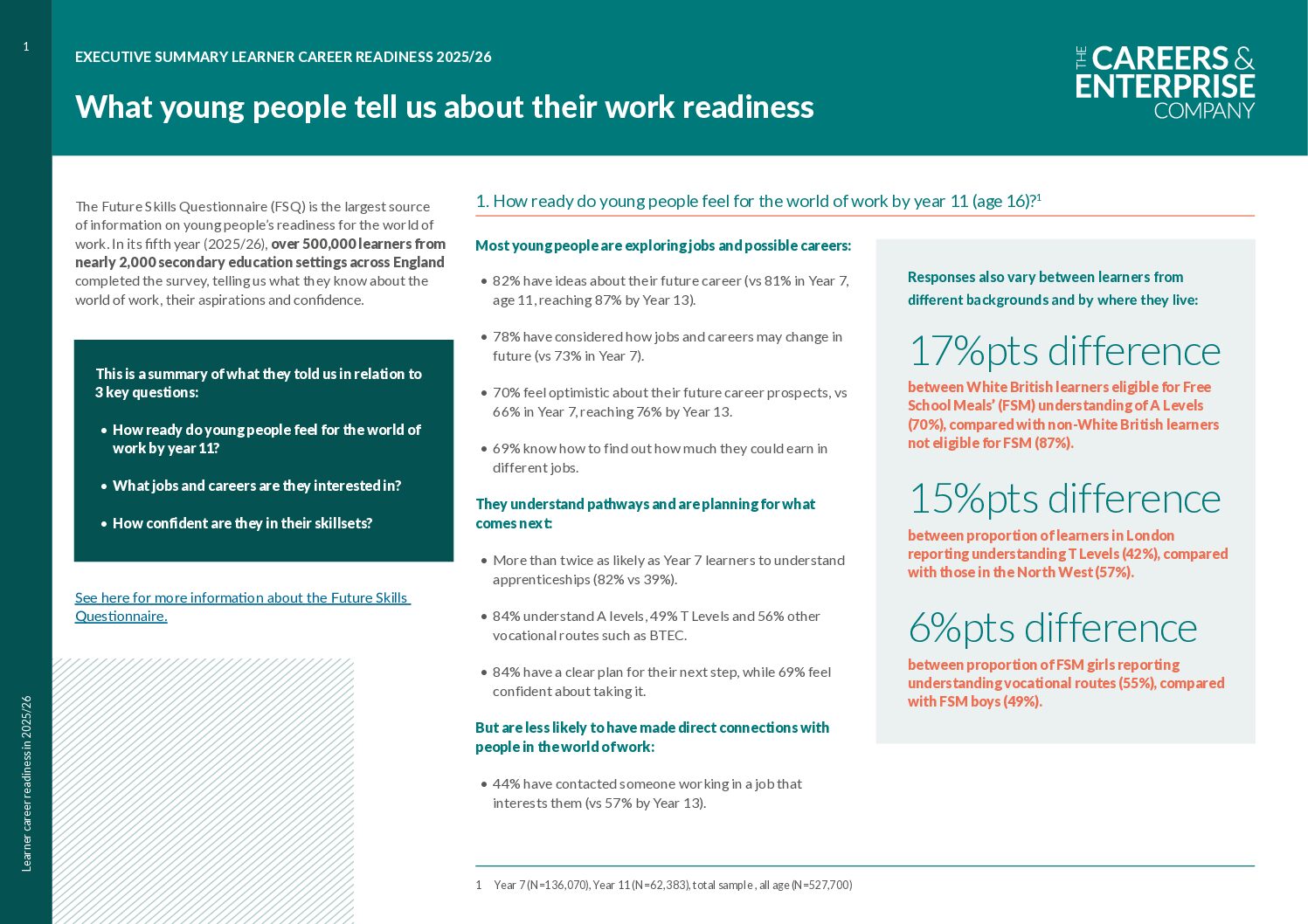
The Learner career readiness in 2025/26 report draws on responses to the Future Skills Questionnaire (FSQ), with more than 500,000 learners from nearly 2,000 secondary education settings across England sharing their aspirations, understanding of career pathways and confidence in their skills.
The findings are encouraging, but they also highlight a gap between thinking about a future career and having the experiences and connections needed to make informed decisions.
Young people are thinking about their futures
By Year 11:
However, only 44% of Year 11 learners have contacted someone working in a job that interests them.
That distinction is important. Young people may have career ideas and understand their options, but opportunities to meet employers, experience workplaces and understand what different jobs are really like can help turn those ideas into informed choices.
From understanding to experience
The findings also show that most Year 11 learners believe they understand what employers are looking for. 81% say they know what skills employers need and 78% know how to make a good impression when applying for a course or job. Yet only 66% feel confident talking about their skills in an interview, while 58% understand different recruitment processes, including interviews and assessment centres.
This reinforces something employers have consistently told us through the Kent & Medway LSIP 2026–2029: work readiness matters.
Across the LSIP’s priority sectors, employers have highlighted the importance of communication, professional behaviours, reliability, problem solving and the ability to apply skills confidently in a workplace setting. The LSIP therefore identifies employability and work readiness as cross-cutting workforce essentials, alongside digital and AI capability and other skills needed in a changing economy.
There is also a strong focus within the LSIP on strengthening entry routes and careers visibility, embedding work readiness and creating clearer progression into employment and further training.
What does this mean for Kent & Medway employers?
The FSQ findings underline why employers have such an important role in careers education.
Employer engagement does not always need to mean offering a lengthy placement. Talks in schools and colleges, workplace visits, careers events, mock interviews, mentoring, live projects and short work-experience opportunities can all give young people insights that careers information alone cannot provide.
This is especially relevant in sectors where Kent & Medway employers are looking to strengthen their future talent pipeline.
For example, the LSIP Kent & Medway Annex B includes plans to increase placements, tasters and entry-to-site opportunities in construction, develop an employer-led careers and placements offer for manufacturing and engineering, and strengthen employer-led entry routes in areas including adult social care, creative industries, fresh food and land-based industries, and tourism and the visitor economy.
For a region with a high proportion of SMEs, the LSIP also recognises that employer engagement needs to be straightforward and realistic. Smaller firms may have limited capacity to host placements and can face practical barriers to engaging with the skills system. The LSIP therefore identifies simpler brokerage, signposting and shared approaches as important ways to enable SMEs to participate more consistently.
Starting earlier and using evidence to target support
Another important message from the research is that career readiness should begin early. Career ideas are already forming in Year 7, while understanding of pathways and confidence develops later. The findings also show differences according to learners’ backgrounds and where they live, demonstrating why headline measures alone do not tell the whole story.
For Kent & Medway, this strengthens the case for using learner voice alongside employer insight and labour market information.
The LSIP provides the employer-led evidence of the skills and workforce needs of the local economy; the FSQ helps us better understand how young people view their own readiness and aspirations.
Bringing those perspectives together can help employers, education providers and careers partners build clearer connections between what young people are considering, the opportunities available locally and the skills businesses will need in the years ahead.
Most importantly, employers can help young people move from knowing about work to experiencing and understanding it.
Read the Learner career readiness in 2025/26 report below or click here for more info